October 15, 2013

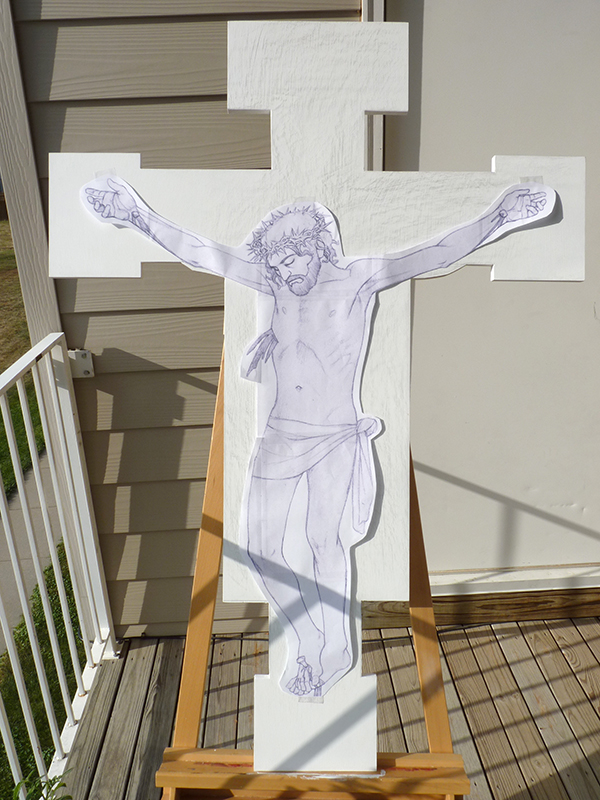
Crucifix Process 3

I've been so busy lately I have not taken the time to post any process photos from the crucifix. These will not bring you totally up to its current state—they were taken between Sept. 18 and Oct. 9. Please forgive me for just dumping these without too much explanation—I've got to get back to work. I have less than two weeks to finish it!

I noticed the plywood had warped after application of the
gesso, so I screwed two 1x2s to the back to straighten it.


The molding is shaped to the contours of the body, to
help give the impression the corpus is overlapping it.

Where the molding isn't perfectly flush with the ply-
wood, I built up wood filler to make a seamless plane,
and sculpted the corners if they weren't perfect.

All of the molding is in place.


After a lot of sanding and about 6 coats of gesso, I'm
ready to apply the drawing to the cross!

October 7, 2013

How We've Murdered Liturgical Art: Part I


This series of posts discusses a book written by a professor at Carthage College, published by Concordia Publishing House, and used as a required text at Concordia University NE in the 1970s. It is entitled "The Christian Encounters the World of Painting," by Wendell Mathews. The book purports to be a guide for Christians to approaching and critiquing modern painting. While claiming to be a proponent of Christian art, Mathews is clearly part of the problem—he is one of the many Christian voices that contributed to the murder of the liturgical arts in the past century. I intend to show exactly how.

In his book, Dr. Mathews wields four weapons against the art of the Church. Not surprisingly, they are the standard poison of Modernism, but have been carefully disguised with theological language in order to be more readily swallowed by Christians. They are: 1) undermining tradition, 2) promoting elitism, 3) attacking semantics, and 4) fostering an improper view of vocation.

1. Undermining the Christian Tradition

A hallmark of Modernism was the sudden break from tradition. Spectacular mental acrobatics were required by Modernist art critics—championed by Clement Greenberg—in order to attach abstract expressionism (and other -isms) to some kind of linear, historical significance. Greenberg felt it necessary to historically justify that which had nothing at all to do with thousands of years of artistic precedent. Other Modernists, however, felt the need to neither deny nor justify the obvious break from tradition. The Futurists, for example, would have burned the museums to the ground, if Marinetti's manifesto had been carried out in reality.1

Dr. Mathews is not one of those overtly iconoclastic Modernists, however. He has good intentions. But he appears to be under two related delusions: that Modernist painting is a continuation of the artistic tradition, but that the painting of past eras has no significance to people living in the present:
After a long period of indifference to the major stylistic trends of recent decades, the church is questioning whether it can relate adequately to the present age by means of outmoded art styles. Some in the church have known for some time that the use of past styles has alienated artists interested in stylistic innovations that emerge from creative activity.1
I quoted a portion of this statement in the Introduction post, but Mathews apparently believes it so strongly that he says it twice. But take special notice of the things he glosses over as though they were self-evident: that traditional styles are "outmoded," and that the use of past styles "alienates" creative artists. Mathews does not spend much time trying to explain exactly why something that was painted for Christians in 1600 cannot relate to Christians of today. Mathews does explain, however, that symbols used in past centuries may fall out of use. He writes,
Visual symbols are born and die. They die when they can no longer produce the special response that the viewer associates with the object. For this reason, many old visual symbols once alive to church members have now lost their power to communicate. But out of the contemporary involvement should arise new and meaningful symbols.2
Okay. So by this are we to believe that when people no longer know what a shepherd is, we should substitute "Jesus is my homeboy?" Well, he has an answer for that.
Some have suggested that all the old visual symbols... should be discarded because they communicate only when they are explained. It is true that some symbols have lost their power to communicate, but this should not apply to a large number of symbols that come to us directly from the Bible. We should not discard symbols of the lamb and the Good Shepherd because we are now more urban-oriented than people of Bible times. ... If such symbols lose their meaning, it reflects weakness on the part of the members of the Christian church.3
I suspect that it's rare for someone to so thoroughly shoot himself in the foot as Mathews has done here. So far, this has been his only concrete reason for doing away with "past styles" of art, and it really has nothing at all to do with the styles, but with the substance. But after saying that symbols that no longer communicate should be replaced with new symbols, he then rebukes this viewpoint as a weakness of faith. And even though he argues that only biblical symbols should enjoy a special protection from disuse, it still requires educating the believers as to their meaning and value. What possible excuse could one have, then, for ignorance toward other well-established but non-biblical symbols (for instance, the Chi-Rho)? None whatsoever.

This leads us to conclude that this cannot be his real and only reason for marginalizing Christian art of the past. Dr. Matthews' motives are only hinted at when he defines what "authentic" art is: "A Christian painting should be authentically artistic. In the world of painting, a work is authentic within a particular cultural and artistic continuum."4 He goes on to say that "individual style, however, should show also the style of his own historical and artistic epoch."5 This is his ace in the sleeve. Whatever a person might say about timelessness, symbolism, or the power to communicate, he can simply counter by saying, "But that art does not participate in the current artistic idiom; therefore it isn't authentic."

So let's recap. Remember how Mathews began by saying that certain styles cannot "relate adequately to the present age?" As it turns out, that was just the first part of a classic bait-and-switch. His argument really has nothing to do with whether or not past art can relate or communicate with Christians today, because he knows this argument has no legs. Instead, he tries to convince you that any art that isn't a product of the mainstream culture cannot ever be "authentic."

Why is this dangerous to Christianity—and how did it kill liturgical art?

It turns out that Dr. Mathews is not really saying anything new. He has fallen prey to the age-old infatuation with the present—that the best music, poetry, art, science, and everything, is happening now. It must be exhilarating to think of one's self riding on the crest of progress, even affecting that progress. The trouble is that this kind of ego- and sociocentricity has nothing to do with Christianity. Christianity teaches that since the Fall into sin, man is utterly corrupt and has nothing to offer God. Furthermore, society at large has been on the express train to hell—and it's picking up speed. Mathews doesn't deny this. He correctly describes the Christian's relationship to the world as one of "mediation." He then explains,
The Christian relationship centers in God's grace, mediated to man in and through the God-man, Jesus Christ, the Son of God. This gift was bought with His great sacrifice, revealing the fullness of divine love. Christ's love becomes the power for Christian action. The Christian's faith is to be active in love.6
The wording is theologically vague, but I think we could all agree with that statement. However, the problem is that what Mathews calls mediation is, to him, social activism. "This acceptance of responsibility means having a critical voice regarding cultural elements contrary to Christian truths."7 The most charitable view of Mathews' writing would be that he wants art to engage nonbelievers in a theological dialogue. But this is impossible. You can tell the Parable of the Good Samaritan to an atheist, and he will fancy himself to be the Good Samaritan. Images do not change a person's orientation to God. As highly as I regard ecclesiastical art, it does not have the power to evangelize nonbelievers—it is not a means of grace.

Vestment for Mass by Manessier
Besides the futility of this supposed evangelism effort, all it has accomplished is to scrape the beauty and meaning from art in order to present to an unbelieving culture something that Dr. Mathews hopes they can "relate" to. Where does that leave Christians? I did not find one single sentence in the book that distinguished art made for galleries from art made for worship. To Mathews, I suspect that they are the same thing. And this is why it is so fatally damaging to liturgical art. In 2000 years of art history, Christian art was made primarily for either devotional purposes or for worship. In both respects, it was made for Christians. No one deluded himself into believing that showing an image of Jesus would convert the heathens. (They suffered from other delusions, but probably not this one.) So it is exceedingly stupid to expect that the church of this age should lower its artistic standards to the tastes and aesthetic of a culture that is in every respect ruled by Satan.

But the biggest reason why this disconnect from tradition is damaging to liturgical art and to Christianity is that, while attempting to use the visual language of Modernism, it has jettisoned the narrative of Salvation in exchange for the subjective feelings of the artist. Modernist painting and sculpture, because it abandoned representational art, could only use abstraction to convey a visceral, barely definable, subjective experience. This art is incapable of expressing the reality of the Incarnation, because it refuses to acknowledge any reality at all.

History has now played out this costly artistic experiment. It has failed utterly. The attempt to make Christian art that "relates" to the iconoclastic culture of our times has resulted in: no significant theological dialogue, no new converts as a result, a Christian church disenchanted with art, talented artists who have either been estranged by the church or who have squandered their talent in an effort to gain mainstream acceptance, and a lifeless body of liturgical art.

To be continued...

_______________

1 "Come on! Set fire to the library shelves! Turn aside the canals to flood the museums! ... Oh, the joy of seeing the glorious old canvases bobbing adrift on those waters, discoloured and shredded. ... Take up your pickaxes, your axes and hammers and wreck, wreck the venerable cities pitilessly!" Filippo Tommaso Marinetti, “The Foundation and Manifesto of Futurism” (1909), quoted in: Michael Darling, Target Practice: Painting Under Attack, 1949-78 (Seattle: Seattle Art Museum, 2009), 130.
2 Wendell Mathews, The Christian Encounters the World of Painting (St. Louis, MO: Concordia Publishing House, 1968), 92.
3 Ibid, 93.
4 Ibid, 90.
5 Ibid.
6 Ibid, 89.
7 Ibid.

September 18, 2013

Intro: How We've Murdered Liturgical Art


Anyone who has heard me talk about Modernism probably has heard me refer to it as the "twentieth century iconoclasm." At a presentation I gave last week, I explained that anyone interested in making artwork for the church, was, by the 1950s, being trained in the paradigm of "art for art's sake." Christians were readily abandoning the artistic tradition of the church and pounding Jackson Pollack over the heads of anyone who picked up a brush. And I only recently realized how true this really was.

A few months ago, my aunt was downsizing, and asked if I wanted any of her art books from college. She attended Concordia University Nebraska in the 1970s, where she studied art. I couldn't turn down the opportunity to add to my library, no matter how old or outdated the books were, so I took them all home with me. On the top of the box I saw a book entitled: "The Christian Encounters the World of Painting," by Wendell Mathews. The book was published by Concordia Publishing House in 1968. According to the biography on the back, Dr. Mathews was a professor and chair of the art department at Carthage College (ELCA) in Kenosha, Wisconsin. I am always interested in the convergence of art and theology, so I picked it up and began to read.

By the second paragraph of the preface, my hopes of reading an informative, insightful book were extinguished by some very familiar Modernist rhetoric:
Many Christians—both ministers and laymen—are encouraging a fresh consideration of the church's relation to the arts. After a long period of indifference to the major stylistic trends of recent decades, the church should question whether or not it can relate adequately to the present age by means of outmoded art styles.
After a brief moment of disgust, my curiosity was piqued and I began to read with more interest. This musty, yellowed book was a time capsule; it afforded me the opportunity to read what was actually being taught at a Lutheran college in the 1970s. This was the smoking gun I had been looking for. It became clear to me exactly how involved Lutherans have been in the cold-blooded murder of liturgical art.

The one indisputable fact concerning this murder is the state of the deceased. Anyone can observe the cold, naked state of our churches built in the past 60 years or so. As obvious as it is to me, however, it's the sort of thing one can get used to, and after a few generations, maybe only a handful of people can see a corpse for what it is. I suspect that it requires only a glance at the thousands of churches that were built and furnished in a time when the liturgical arts were very much alive to convince the apathetic layman that a murder has, in fact, occurred. But upon becoming aware of it, the problem does not therefore solve itself. ("Awareness" doesn't cure cancer, either.) The point of educating Christians about what has happened is not to elicit sympathy; neither is it to point fingers. It is to change their perceptions and behavior—to cause them to stop participating in this ongoing iconoclasm and work toward reversing it.

Once their minds have been changed, then the healing can begin. "God is not the God of the dead, but of the living" (Mt 22:32). He who raised Christ from the dead can certainly resurrect the visual arts in his Church. I firmly believe that God will do this. The pendulum has been too long the other way; it is time to bring it back.

But until that happens, there's a lot of work to be done. We've got a corpse on a slab, and I mean to find out how exactly the Bride of Christ was so badly mistreated, and why. And I'm darn sure not going to let it happen again, so help me God.

To be continued...

September 11, 2013

Hope Logo and Explanation


Hope is a word that is so commonplace that we easily forget what it means in the Christian context. “I hope we get rain soon.” “I hope I can get off work on Friday.” “I hope the Bears make the playoffs this year.” In Peter’s first epistle, he writes, “Praise be to the God and Father of our Lord Jesus Christ! In his great mercy he has given us new birth into a living hope through the resurrection of Jesus Christ from the dead, and into an inheritance that can never perish, spoil or fade. This inheritance is kept in heaven for you” (1 Pet. 1:3,4).

This hope that we have is not the wishful thinking that we indulge in every day. It is a 100% certainty made possible by the death and resurrection of Jesus Christ. At the center of the logo, you see the crown of thorns. A prize worth having is not a prize easily won. Jesus suffered the wrath that our sins deserved on the cross, and carried it to the grave. We also must bear our crosses and thorns while we live on earth—Jesus promised this. But in front of the thorns you see that the cross made of lilies, because for Jesus, and for us, death is not the end. His resurrection is also our resurrection.

The tips of the lilies touch an eight-sided ring made of gold. In the Christian church of centuries past, the octagon had special significance for the believer. In the Bible, seven is an important number of completion—there were seven days of creation, and seven days in each week. But Jesus rose from the dead the day after the Sabbath—the eighth day. For us, the eighth day represents a new birth. Therefore, baptistries and fonts were often made with eight sides, to remind believers that we are baptized into Christ’s resurrection. We are new creations, waiting only for new, glorified bodies and the New Jerusalem. God help us to live as his redeemed creations, until the day when we will rejoice forever with Jesus in heaven. This is our hope—and what a certain hope it is!

Hope Evangelical Lutheran Church (ELS) Portage, IN

September 8, 2013

Crucifix Process 2

More progress to report, but I'm still not to the "fun" part yet. Preparing this cross for painting and gilding is definitely going to be the most labor-intensive part. I began by sanding the layers of gesso (about 6 so far) and scraping them smooth with a blade. I made a multi-sheet printout of the sketch at the correct scale, taped the sheets together, and cut them out to make a cartoon. I put Jesus on the cross (oh, how true that is!) where he needed to be, then traced the contours of his arms. I trimmed off the excess with a jig saw (a recent investment), and planed and filed the edges as straight and smooth as I could get them.

This weekend I also purchased the molding that will go around the edges. I cut the first strip to size using a miter box and handsaw and adhered it to the top of the cross. Using some C-clamps and folded pieces of cardboard to soften the force of the clamp on the wood, I clamped the molding to the cross in several places for about 30 minutes.


I applied Elmer's wood glue to the back of each strip and
smeared it to cover the whole surface.


It's a learning process. I learned, for instance, that the cardboard was not very effective in preventing the clamps from denting the wood. So I had to remove the first strip of molding and discard it. It came off very easily, because it was glued to the gesso and not the wood itself. Which also taught me that I should have glued the molding to the cross before applying gesso. So now I'm scraping gesso off from around the edges before I glue the molding down.


I opted for the miter box and hand saw, instead of the
much larger investment of an electric miter saw. Plus,
it's easier to store, and does nearly as good a job.

I'm now using pink pearl erasers instead of cardboard, to
protect the moulding.
As I go along, I've also been filling the gaps in the plywood with wood filler, then sanding it smooth. I'm trying to get as even a surface as possible on the edges, since I plan to gild them. I'm still not sure if the end result will be as good as I'd like it to be. But for the full-size crucifix, I would probably have some sort of framework to attach the cross to, or else attach strips of hardwood to the outside edge.

That's all for now! I might be another week or two in putting on the rest of the molding and finishing the gesso.

September 2, 2013

The Liturgy as Soundtrack

Many of you probably don't know this about me, but I am a soundtrack lover. At some point in high school I was so moved by a John Williams score that I just had to own the soundtrack. From that point on, I have collected a moderate library of movie scores and soundtracks by some of the most prolific composers of our time—Ennio Morricone, Jerry Goldsmith, Michael Kamen, James Horner, and of course, John Williams. If you listen often enough to movie scores without the movie, it really improves your ear for musical story telling. I think it also makes you more consciously aware of that thing that most people think of as "background music," but which has an uncanny ability to manipulate your emotions and make you feel what the composer wants you to feel.


As much as I love good movie scores, and as much as I love Lutheran worship, I have no desire for the two to mix. Whenever the sphere of entertainment bleeds into the sphere of Christian worship, it subverts true worship. And I will be so bold as to say that it does so as a rule. The more we try to make worship like a night at the movies or a pop concert, the less our minds are drawn to Christ through Word and Sacrament. I've talked about contemporary Christian music before, but today, I am referring to something else. Specifically, I have in mind two liturgies from Northwestern Publishing House, published in the Christian Worship Supplement (CWS), called "Gathering Rite on Holy Baptism" and "Gathering Rite on the Word of God."

(On a side note: I have no clue what the historical significance of a gathering rite is, if indeed there is any. I have a hunch that it is a relatively recent product of Vatican II. Five bucks to the first person who can cite a source.)

I first experienced the gathering rites in Georgia, when our church was using the CWS quite often. (In fact, it seemed like we exclusively used liturgies from the Supplement, and never from the hymnal. My wife and I had to be very persistent with our pastor in order to get the Common Service back into the rotation.) The texts are quite good, and the hymn verses are appropriate. But musically, they are utter failures. If you have never been made to participate in the CWS gathering rites, count yourself lucky. I will try to recreate the experience for you.

Start by imagining that you are not in worship, but in a Hallmark movie, which happens to be set in a Lutheran church. (Alternatively, imagine you're in a WELS Connection video.) Instead of the pastor and the congregation reading and singing responsively, they are speaking over the top of choreographed music, which transitions into a hymn verse between each section of the response. The congregation awkwardly fades in, because the only one who knows when to start singing is the pastor—and only because he has rehearsed it dozens of times. But sometimes the pastor's timing will be a little slow in speaking the absolution, and then the MIDI player will have started the refrain already. The gathering rites completely frustrated a life-long Lutheran such as myself, and I can only imagine the total resignation of a first-time visitor.

Of course, what might have gone more smoothly with a live organist who can constantly adjust tempo and volume was sabotaged completely by a mindless computer. But that's another topic. The point is that even if there had been an organist and a pastor who had rehearsed the liturgy to perfection, and even if life was like a Rogers and Hammerstein musical where everyone knew exactly when to sing, you still have demoted the liturgy to the role of soundtrack. Now I'll explain why that's a bad thing.

First, the liturgy is designed to bear the texts of Scripture. It is not there just to sound beautiful, or to fill dead space with sound. If that was the case, we could just insert our favorite Bach CD and proceed as normal, with the confidence that our worship is being adorned with the best music mortal man has to offer. But problems always result from people thinking that music and the arts serve only a superficial purpose—that of pleasing the senses. Such an approach naturally causes confusion between worship that employs the arts, and entertainment, which also pleases the senses.

Second, someone who would plan for "quiet keyboard music" to be played while people are engaged in spoken liturgical responses has no real appreciation for the power and art of music. Luther wrote,
It was not without reason that the fathers and prophets wanted nothing else to be associated as closely with the Word of God as music. Therefore, we have so many hymns and Psalms where message and music join to move the listener's soul. ... After all, the gift of language combined with the gift of song was only given to man to let him know that he should praise God with both words and music, namely, by proclaiming [the Word of God] through music and by providing sweet melodies with words.1
Music is just so much emotional sensation without the addition of human language in the form of song. So the composer of these gathering rites is not using music for the purpose God gifted it for—that of elevating the truths of scripture. Instead, he is striving for "ambiance," making it the musical equivalent of wallpaper.

Except that to call it musical wallpaper is being overly charitable. Because wallpaper can be pretty, or it can be distracting. But it could never so actively compete with the liturgy as does the musical accompaniment to the CWS gathering rites. Ask any film composer what he would do when there is important dialogue, and he'll say that the music has to get out of the way—there are plenty of other opportunities for a composer to show his skill. Experienced composers know that if the music is not supporting the dialogue by way of song, it is competing with it. But it is also common sense; two signals that are not in harmony result in noise. And when you have something as important as confession and absolution happening, it should not have to compete with anything.

For the above reasons, the CWS gathering rites do not show the high respect for music in general, and the liturgy in particular, that Luther showed for them. Their existence reflects little more than our synod's general infatuation with variety. "Variety to enhance a sense of the season" is touted as the first useful feature of a gathering rite in the WELS worship resources for Advent. The trouble with this intended use is that when you use a single, poorly-written rite for a whole season, say, Easter, or Lent, you'll never want to hear it again by the end. It seems that the authors of the above resources must have been aware of this, commenting that one particular gathering rite may not have a "life span" of more than a few years.2

Is there anyone who needs variety so badly that he must push these piecemeal soundtrack liturgies over on his congregation? (Put your hands down; it was a rhetorical question.)

The (potentially) good news is that the WELS is asking for input on its new hymnal. Polling the public for advice on hymnal-making could be disastrous, or it could be good. Or it could mean that the person currently in charge of the hymnal project isn't really sure how to go about it. I'm not sure, either. So I encourage you to go and submit to him good, sensible, biblical advice as to which hymns and liturgies to continue using, and which to avoid.

_______________

1 LW 53:323-24, quoted in Carl F. Schalk, Luther on Music: Paradigms of Praise (St. Louis, MO: Concordia Publishing House, 1988), 37.
2 "Gathering Preparation," WELS Connect (Oct. 24, 2011), https://connect.wels.net/AOM/ps/worship/Church%20Year%20Planning%20Documents/1%20Advent%20through%20New%20Year/Advent/Advent%20Gathering%20Rite%20-%20Browning/Gathering%20Preparation.rtf (accessed September 2, 2013).